Cabling & Connectivity Products: The Foundation of Your Business Network
n the fast-paced business landscape of the UAE, the foundation of your digital operations is built upon an often-overlooked, yet critical, layer: your physical network infrastructure. The pressure to choose the right components for a new office or a major upgrade can be immense. Navigating the technical jargon of Cat6, Cat6a, and multi-mode fiber often leads to uncertainty, creating the risk of investing in outdated technology that hinders future growth. A robust network is the lifeblood of your productivity, and making the wrong choice can lead to significant operational disruptions.
This is where a strategic understanding of cabling and connectivity products becomes a powerful business asset. This guide demystifies the core components that form the backbone of a high-performance network. We will provide the clarity you need to select the right solutions for your specific business requirements in Dubai and across the UAE, ensuring your infrastructure is not just functional, but a fortress built for reliability, speed, and future expansion. By the end, you will be equipped to make confident decisions that drive your business forward.
Why Cabling & Connectivity is a Strategic Business Asset
In today's hyper-connected business environment in the UAE, it's easy to overlook the physical foundation of your network. Many organizations operate with an "it's just a wire" mentality, failing to recognize that their cabling infrastructure is the central nervous system of their entire operation. This is a critical oversight. Your network cabling is the physical layer of your digital fortress; a weak foundation compromises every digital asset, application, and security measure built upon it. High-performance cabling and connectivity products are not an expense—they are a strategic investment that directly fuels tangible business outcomes like enhanced speed, superior employee productivity, and dramatically reduced downtime.
To better understand the fundamental components of a well-organized network, this video provides an excellent introduction:
The Cost of Poor Connectivity
Substandard cabling directly translates to operational inefficiency and financial loss. A weak network foundation creates performance bottlenecks that throttle data flow, leading to slow application response times and frustrated, unproductive employees. The risks extend beyond mere inconvenience, exposing your business to intermittent service interruptions and even data loss during transmission. Furthermore, an outdated infrastructure severely limits your ability to adopt modern technologies like high-definition video conferencing, robust cloud services, or advanced VoIP systems, effectively capping your company's growth potential.
Building for Tomorrow: Future-Proofing Your Network
A proactive approach to your network infrastructure is essential for long-term success. This means investing in a robust structured cabling system that exceeds your current bandwidth requirements. As demand from IoT devices, 4K video streaming, and cloud-based applications continues to surge, the capacity of your network will be tested. In the UAE market, the primary cost of a cabling project is labor, not materials. The marginal difference in cost between standard and high-specification cable is minimal compared to the thousands of Dirhams (د.إ) required to re-wire an entire office. Choosing the right cabling and connectivity products from the start is an ironclad strategy to save significant capital and avoid future operational disruptions.
Core Cabling Products: Copper vs. Fiber Optic Solutions
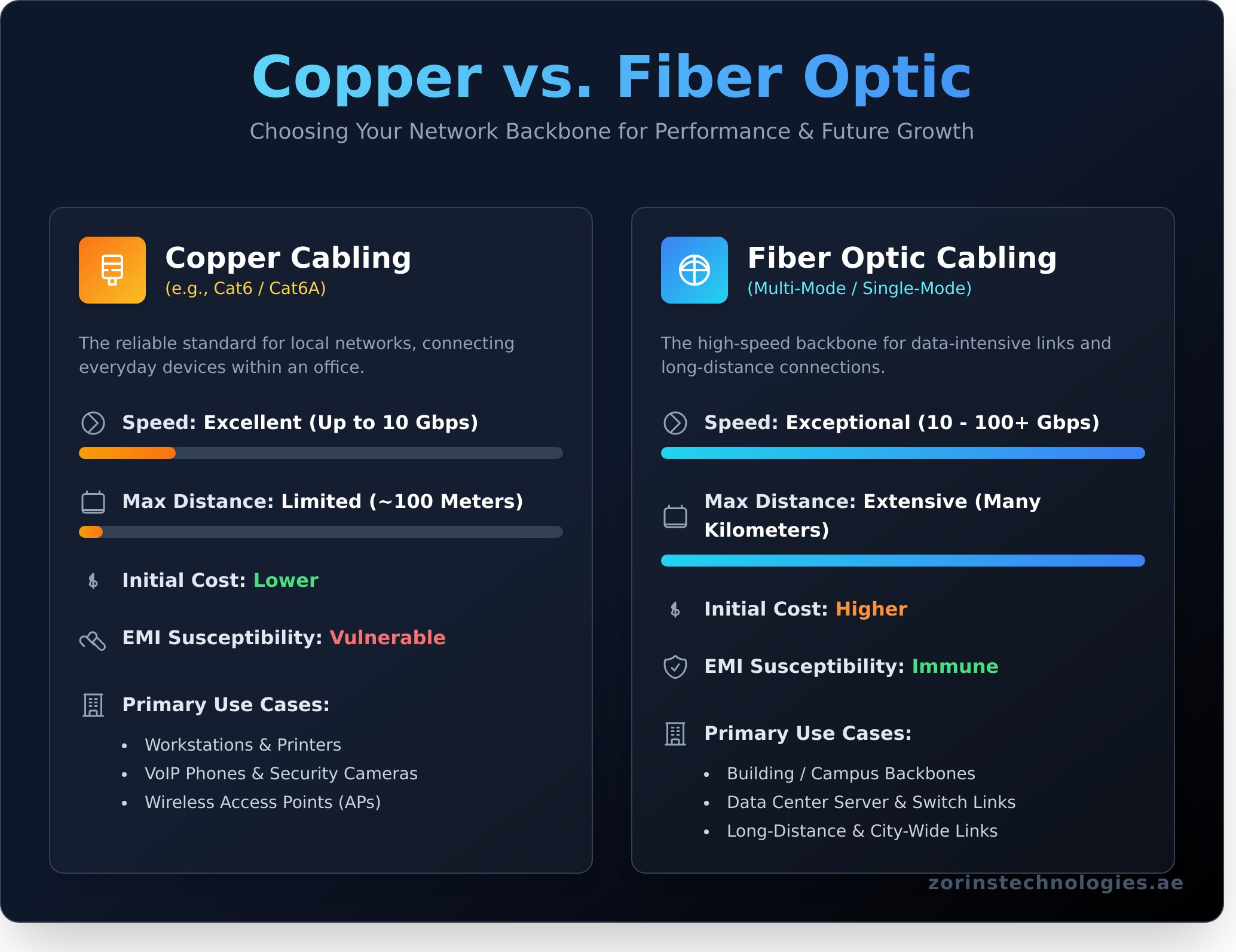
Selecting the right cabling and connectivity products is a foundational decision that dictates your network's speed, reliability, and future scalability. To simplify this choice, think of your network infrastructure as a transportation system. Copper cabling is the reliable, comprehensive road network connecting every local destination, while fiber optic cabling is the high-speed maglev train, linking major hubs with unparalleled speed over vast distances.
Each technology serves a distinct, mission-critical purpose. Understanding their core strengths allows you to build a robust and cost-effective network tailored to your business needs in the UAE. Here is a high-level comparison:
CharacteristicCopper Cabling (e.g., Cat6/Cat6A)Fiber Optic CablingSpeedExcellent (Up to 10 Gbps)Exceptional (10 Gbps to 100+ Gbps)Max DistanceLimited (Up to 100 meters)Extensive (Many kilometers)Installation Cost (AED)Lower initial cost per connection pointHigher initial cost for equipment & laborInterferenceSusceptible to electromagnetic interference (EMI)Completely immune to EMI
Understanding Copper Cabling (The Ethernet Standard)
Copper Ethernet cables are the workhorse of modern office environments. For new installations, we deploy Category 6 (Cat6) and Category 6A (Cat6A) cables as the robust standard. These provide the bandwidth necessary to streamline operations, supporting high-speed data transfer and Power over Ethernet (PoE) devices. Legacy Cat5e cabling remains a viable, cost-effective option for less demanding applications like VoIP phones or standard workstations.
Primary Use Cases: Connecting workstations, printers, VoIP phones, security cameras, and wireless access points to the local network.
The Power of Fiber Optic Cabling
Fiber optic cabling transmits data as pulses of light, offering a quantum leap in performance. This technology is the backbone of high-performance networks. Multi-Mode (OM3/OM4) fiber is the cutting-edge choice for high-throughput links within a building or data center, such as connecting server racks and network switches. For long-distance requirements, Single-Mode (OS2) fiber provides an ironclad connection across a corporate campus or between city-wide offices, making it essential for modern UAE enterprises. The importance of broadband infrastructure highlights why such high-capacity links are vital for economic growth and innovation.
Specialized and Legacy Cabling
While copper and fiber are dominant, some specialized cabling and connectivity products still serve vital roles. Coaxial cables, for instance, are often used in specific applications like CCTV surveillance systems or as the final-mile connection for certain broadband services. Deploying the correct cable for its intended purpose is not just a recommendation; it is a requirement for guaranteeing network integrity, security, and peak performance.
Essential Connectivity Hardware: Connecting the Dots
High-performance cables form the arteries of your network, but they are inert without the mission-critical hardware that connects them. The right cabling and connectivity products transform a bundle of wires into a cohesive, high-speed data ecosystem. The quality of these components—from the smallest connector to the largest cabinet—is as crucial as the cable itself. A single substandard jack can compromise an entire data link, creating bottlenecks that hinder productivity and expose your operations to risk.
[Diagram: A visual representation of a network closet showing a server rack, patch panel, switch, and cable managers, illustrating how all components interconnect.]
Termination & Organization: Patch Panels and Keystone Jacks
A structured cabling system relies on meticulous organization. Patch panels act as the central switchboard, providing a fixed, organized hub where cables from across your facility terminate. This allows network switches to be connected cleanly and logically. At the user end, keystone jacks provide modular connection points in wall plates, creating a professional and adaptable interface. This approach, governed by ANSI/TIA-568 structured cabling standards, ensures that moves, adds, and changes can be performed at the patch panel, streamlining maintenance and eliminating the need for costly re-cabling.
The Endpoints: Connectors, Adapters, and Patch Cords
Every data journey ends at a connection point. For copper cabling, the ubiquitous RJ45 connector is standard, while high-speed fiber optics typically rely on LC or SC connectors. These endpoints are linked to devices using patch cords—shorter, flexible cables that connect a computer to a wall outlet or a server to a switch. For maximum reliability and performance, we always recommend factory-terminated patch cords. They are manufactured in a controlled environment, ensuring a perfect connection that minimizes signal loss and provides an impenetrable link for your data.
Housing & Management: Racks, Cabinets, and Trays
Your core networking equipment requires a secure and organized environment. Server racks and cabinets provide the robust housing for switches, servers, and patch panels, protecting them from physical damage and unauthorized access. Effective cable management, using trays and horizontal or vertical managers, is not merely cosmetic. It protects wiring from kinks and stress, ensures proper airflow to prevent overheating, and drastically simplifies troubleshooting. A well-managed rack is the hallmark of a professional, resilient network infrastructure.
Selecting the right combination of these components is fundamental to building a network that can support your strategic business goals. The integrity of your entire IT infrastructure depends on these foundational cabling and connectivity products. At Zorins Technologies, our experts design and deploy robust, structured solutions tailored to the unique demands of businesses across the UAE, ensuring your network foundation is built for peak performance and security.
DownloadFeedback & RecreateDelete
How to Select the Right Products for Your Business in Dubai
Selecting the ideal cabling and connectivity products is a strategic decision that directly impacts your operational efficiency, security, and future growth. Moving beyond technical specifications to focus on core business requirements ensures your investment delivers sustained value. For businesses in Dubai, this process involves a methodical evaluation of your performance demands, physical environment, and technology partners.
Step 1: Assess Your Bandwidth and Application Needs
Your daily operations dictate your network's performance requirements. Consider mission-critical activities like large file transfers, high-definition video conferencing, and constant access to cloud-based applications. It is crucial to also anticipate future demands. Are you planning to expand your team or integrate data-intensive technologies like IoT? As a robust rule of thumb, we recommend Cat6A cabling for all new office installations in the UAE to future-proof your infrastructure for 10Gbps speeds and beyond.
Step 2: Evaluate Your Physical Infrastructure
The physical environment presents unique challenges that your cabling infrastructure must overcome. Key factors include:
Distance and Layout: Are you connecting multiple floors within a high-rise tower or linking separate facilities across an industrial zone? The solution will differ significantly.
Environmental Interference: In manufacturing or industrial settings, electromagnetic interference (EMI) from heavy machinery can disrupt network signals. Shielded cabling may be required to ensure stable connectivity.
Regulatory Compliance: All installations in the UAE must adhere to strict local building and safety codes, including those mandated by Dubai Civil Defence (DCD). Using certified, low-smoke zero-halogen (LSZH) cables is often a requirement to ensure safety.
Step 3: Partner with a Trusted Technology Supplier
Sourcing your cabling and connectivity products from unverified suppliers exposes your business to significant risks, including counterfeit goods that cause network failures and create security vulnerabilities. Partnering with an official, trusted technology provider like Zorins Technologies eliminates these threats. We provide guaranteed authentic, high-performance products from world-class brands and offer expert guidance to design a seamless, robust, and compliant network foundation. Protect your investment and ensure your network is built for peak performance. Get a professional consultation for your cabling project.
Fortify Your Network’s Core for Future Growth
In the competitive landscape of Dubai, your network's physical infrastructure is not a mere utility—it is the strategic bedrock of your entire operation. As we've detailed, making the right choice between copper and fiber solutions and selecting the appropriate hardware are critical decisions that dictate your company’s speed, reliability, and future scalability. A robust, well-planned network is non-negotiable for sustained success.
Investing in superior cabling and connectivity products is the first step, but expert implementation is what guarantees peak performance. With over two decades of specialized IT infrastructure experience in the UAE, Zorins Technologies provides that proven expertise. As an official partner for industry leaders like Cisco and CommScope, we don't just supply components; we engineer and deploy impenetrable solutions built for unwavering reliability.
Frequently Asked Questions About Cabling & Connectivity
What is the main difference between Cat6 and Cat6A cabling?
The primary distinction lies in performance and bandwidth. Cat6A supports a higher frequency of 500 MHz and delivers robust 10 Gigabit Ethernet speeds up to the full 100-meter distance. In contrast, Cat6 is limited to 250 MHz and can only reliably sustain 10 Gigabit speeds up to approximately 55 meters. Cat6A is also physically thicker with superior shielding to prevent crosstalk, making it the definitive choice for future-proofing your network infrastructure against increasing data demands.
When does my business need to invest in fiber optic cabling instead of copper?
A strategic investment in fiber optic cabling becomes essential for high-speed network backbones, long-distance runs, and environments with high electromagnetic interference (EMI). This is critical for connecting separate buildings or linking floors in the UAE's high-rise towers. While copper is cost-effective for standard desktop connections, fiber provides the mission-critical speed and signal immunity necessary for data centers and linking network distribution frames, ensuring your operations run with maximum uptime and security.
What is 'structured cabling' and why is it important?
Structured cabling is a standardized and highly organized approach to your network's physical infrastructure, encompassing everything from patch panels to wall outlets. Its importance is paramount; unlike haphazard point-to-point wiring, a structured system provides a scalable, reliable, and easily managed foundation for your business. It dramatically reduces downtime, simplifies troubleshooting, and ensures your network can support future technological advancements, making it a vital long-term asset for operational continuity.
Can I use cabling products from different brands together?
While components from different manufacturers may be technically interoperable if they meet the same industry standards, we strongly advise against this practice. Mixing brands can create subtle performance bottlenecks and significantly complicates warranty claims, as vendors may attribute failures to other manufacturers' products. For an ironclad and reliable network, an end-to-end solution from a single, reputable brand ensures every component is engineered to deliver certified, optimal performance together.
How can I ensure the products I'm buying are genuine and high-quality?
To fortify your digital landscape, you must procure components exclusively from authorized distributors and certified IT partners. Always verify that products carry certifications from recognized bodies like UL or ETL, which guarantee compliance with stringent safety and performance standards. Avoid suspiciously low-priced items from unverified online sources, as these are often counterfeit. Investing in genuine, high-quality cabling and connectivity products is a proactive measure to safeguard your network's integrity and prevent costly failures.
What are the most common causes of network failure related to cabling?
The vast majority of cabling-related network failures originate from two sources: improper installation and substandard components. Common installation errors include exceeding a cable's maximum bend radius, poor connector termination, and overtightened cable ties, all of which degrade signal integrity. Furthermore, the use of low-quality or counterfeit patch cords and jacks introduces critical weak points. These physical layer vulnerabilities are a primary source of intermittent connectivity issues and catastrophic network outages.