Top 7 Cloud Migration Benefits for Businesses in United Arab Emirates
n the dynamic UAE market, are escalating IT costs and the complexities of managing physical servers hindering your growth? The constant cycle of capital expenditure on hardware, from servers to cooling systems, can drain resources that could be invested in innovation. For many UAE businesses, the path to greater efficiency and security lies in understanding the transformative cloud migration benefits available today.
Moving your operations to the cloud is no longer a question of 'if,' but 'how' to maximize the return. It's about converting unpredictable capital outlays in Dirham (AED) into predictable operational expenses, reinforcing your security against sophisticated threats, and achieving the agility to scale instantly with market demand. In this guide, we reveal the seven critical advantages that empower businesses across the Emirates to reduce costs, simplify compliance, and build a resilient foundation for future growth.
Financial Transformation: From Capital Expense (CapEx) to Operational Expense (OpEx)
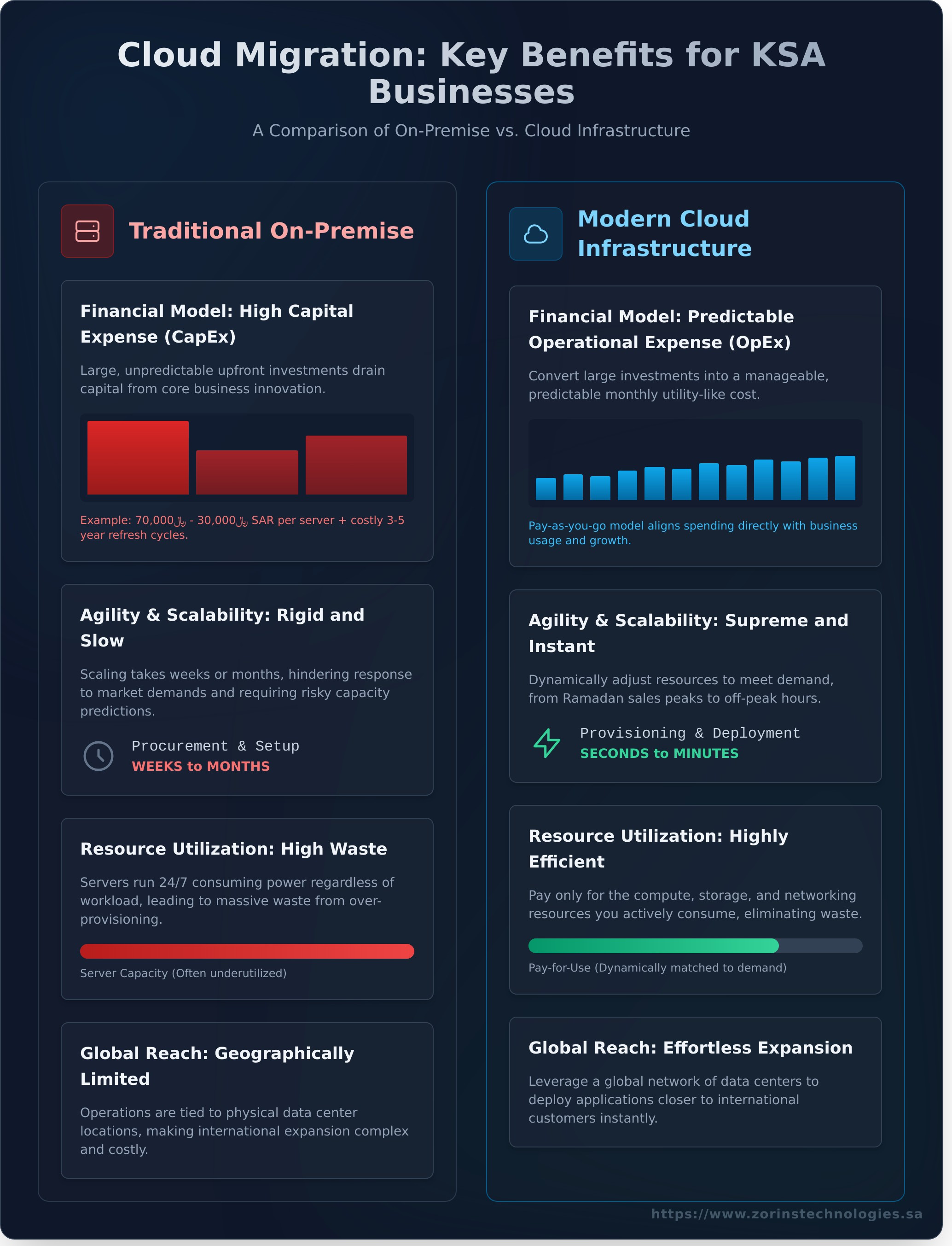
For businesses in United Arab Emirates, one of the most compelling cloud migration benefits is the fundamental shift in IT financial strategy. The traditional on-premise model requires significant Capital Expenditure (CapEx)-large, upfront investments in physical hardware, data center space, and supporting infrastructure. Cloud computing transforms this into a predictable Operational Expense (OpEx), allowing you to pay for technology as a subscription service, much like a utility. This strategic change preserves capital and aligns technology spending directly with business usage and growth.
Eliminate Large Upfront Hardware Costs
Instead of purchasing new HPE or Dell servers for tens of thousands of Riyals (e.g., ﷼30,000 - ﷼70,000 SAR per unit), you can provision enterprise-grade virtual instances in the cloud within minutes for a fraction of the monthly cost. This model eliminates the entire hardware lifecycle of procurement, maintenance, and disposal. The costly and disruptive hardware refresh cycle, typically occurring every 3-5 years, becomes a thing of the past, freeing up substantial capital for core business innovation.
Achieve Predictable Monthly Spending
Cloud services translate complex IT infrastructure costs into a clear, predictable monthly bill. This operational predictability is invaluable for financial forecasting and departmental budgeting within Saudi enterprises. Leading cloud providers like AWS and Azure offer sophisticated cost management tools and alerting systems, providing complete transparency and control over your spending. This allows your finance team to manage IT as a consistent operational cost rather than an unpredictable capital burden.
Optimize Resource Allocation and Reduce Waste
The pay-as-you-go model is a cornerstone of cloud efficiency. You only pay for the compute, storage, and networking resources you actively consume. This concept, central to any Cloud Computing Overview, prevents the massive waste associated with over-provisioning. For example, a Saudi e-commerce platform can automatically scale down resources during late-night off-peak hours, significantly reducing costs. This stands in stark contrast to on-premise servers, which run 24/7 and consume power regardless of the actual workload, representing a constant drain on resources.
Unlocking Supreme Agility and Scalability
In the dynamic and rapidly expanding Saudi Arabian market, the ability to adapt is not just an advantage-it is a core requirement for survival and growth. Traditional on-premise infrastructure is rigid, requiring significant time and capital to expand. One of the most transformative cloud migration benefits is gaining supreme operational agility and near-infinite scalability. This means your enterprise can respond to market opportunities and challenges in minutes, not months.
In a cloud environment, scalability is the capacity to dynamically adjust your computing resources. You can "scale up" by adding more power (CPU, RAM) to a server, or "scale out" by adding more servers to your network. Crucially, you can also "scale down" when demand subsides. Consider a major KSA retailer preparing for a Ramadan sales event. Instead of overprovisioning expensive hardware that sits idle most of the year, they can instantly scale their cloud resources to handle peak traffic and scale back down post-event, paying only for what they use. This capability provides a decisive competitive edge.
Respond Instantly to Market Demands
The speed of cloud deployment empowers businesses to innovate at an unprecedented pace. New virtual servers and enterprise-grade services can be provisioned in minutes, eliminating the lengthy procurement cycles of physical hardware. This allows your development teams to test new applications and business ideas without committing to costly infrastructure. The result is a dramatically faster time-to-market for new products and services, enabling you to outmaneuver competitors.
Effortless Global Reach
For Saudi businesses with ambitions beyond the Kingdom, the cloud offers a seamless path to international expansion. Leading cloud providers like AWS and Microsoft Azure operate a global network of data centers. This allows you to deploy your applications closer to your international customers, whether they are in London, Singapore, or New York. This geographic proximity significantly reduces latency, delivering a faster, more reliable user experience and strengthening your global brand presence.
Pay-As-You-Grow Infrastructure
One of the most compelling financial cloud migration benefits is the shift from a capital-intensive (CapEx) model to a flexible, operational (OpEx) one. You no longer need to make high-risk predictions about future capacity needs and invest millions of Riyals in hardware. This operational model is so crucial for national development that the World Bank Cloud Strategy Report highlights its role in enabling Saudi Arabia's Vision 2030 objectives. Your infrastructure grows in lockstep with your business, ensuring sustainable growth without the burden of risky capital outlays.
Fortifying Security and Simplifying Compliance
A common hesitation in digital transformation is the belief that on-premise infrastructure offers superior control and security. However, for organizations in Saudi Arabia, one of the most powerful cloud migration benefits is gaining access to a security and compliance posture that is often unattainable in-house. Leading cloud providers invest billions in creating impregnable defenses and streamlined regulatory frameworks, providing a robust foundation that businesses can build upon with confidence.
Leverage Enterprise-Grade Security
Major cloud platforms operate on a scale that allows for unparalleled investment in security. Their data centers are protected by multi-layered physical defenses, including biometric scanners, 24/7 surveillance, and on-site security personnel. Digitally, they employ global teams of elite cybersecurity experts who work around the clock to monitor and neutralize threats. This enterprise-grade foundation includes advanced, built-in tools for:
Threat Detection: Proactive monitoring and AI-driven analytics to identify suspicious activity.
Network Protection: Integrated firewalls and DDoS mitigation services.
Data Encryption: Automatic encryption for data both in transit and at rest.
Zorins Technologies amplifies these native capabilities, engineering custom security architectures and managed services that layer advanced protection on top of the cloud provider’s infrastructure, ensuring your digital assets remain secure.
Streamline Regulatory Compliance
Navigating the complex regulatory landscape is a significant challenge for Saudi businesses. Cloud providers simplify this by maintaining certifications for global standards like ISO 27001, SOC 2, and PCI DSS. Crucially, they also align with local mandates from the National Cybersecurity Authority (NCA) and the Saudi Central Bank (SAMA). This alignment is a cornerstone of the Kingdom's 'Cloud First' policy, as analyzed in the World Bank report on Saudi Arabia's cloud strategy, which supports secure digital transformation. By leveraging these pre-certified environments, your organization can dramatically simplify audit processes and reduce the compliance burden, another key aspect of the overall cloud migration benefits.
Ready to build a secure and compliant cloud environment? Consult our experts on cloud security for your Saudi business.
DownloadFeedback & RecreateDelete
Enhancing Business Continuity and Disaster Recovery
In Saudi Arabia's dynamic economy, any operational disruption can lead to significant financial and reputational damage. One of the most critical cloud migration benefits is the ability to implement a robust, cost-effective disaster recovery (DR) strategy. Cloud-based DR redefines business continuity by moving away from cumbersome and expensive traditional models, offering enterprise-grade resilience to businesses of all sizes.
Traditionally, building a DR site involved duplicating your entire on-premise infrastructure-servers, storage, and networking-at a secondary location. This approach demands millions of SAR in capital investment and ongoing operational costs, making it unfeasible for many organizations. The cloud transforms this by providing DR-as-a-Service (DRaaS), where you only pay for the resources you consume during a failover event, drastically reducing total cost of ownership.
Automated Backup and Recovery
Cloud platforms provide advanced, automated backup solutions that render manual tape backups obsolete. Services from leading providers enable scheduled snapshots and point-in-time recovery, allowing you to restore data to a specific moment before an incident occurred. This automated process minimizes the risk of human error and ensures your critical business data is consistently protected and rapidly restorable.
Geographic Redundancy for Ultimate Resilience
A core advantage of the cloud is inherent geographic redundancy. Your applications and data can be seamlessly replicated across multiple, physically isolated data centers, including the growing number of facilities within Saudi Arabia. If a localized outage or disaster impacts one data center, automated failover mechanisms instantly redirect traffic to a healthy secondary site, ensuring continuous operation with minimal to no interruption.
Minimize Business Downtime
Downtime is not just an IT problem; it's a business catastrophe. The financial losses and damage to customer trust can be immense. Leading cloud providers guarantee high availability with stringent Service Level Agreements (SLAs), often exceeding 99.9%. Investing in a cloud-based DR strategy is an insurance policy for your operations, and one of the key cloud migration benefits that directly protects your revenue streams and market position.
A well-architected cloud environment ensures your business can withstand unforeseen events, from cyber-attacks to infrastructure failures. Contact our professionals to design a resilient cloud strategy tailored for your business in Saudi Arabia.
Boosting Productivity and Empowering a Modern Workforce
Beyond cost savings and scalability, one of the most transformative cloud migration benefits is the profound impact on your workforce. Adopting the cloud is a strategic imperative for Saudi enterprises aiming to build a more agile, productive, and resilient team. It provides the essential infrastructure to empower employees, streamline operations, and foster a culture of innovation that aligns with the dynamic goals of Vision 2030.
Enable Secure Remote Access
Cloud platforms are engineered for secure, authenticated access from any location. This enables your teams in Riyadh, Jeddah, and across the Kingdom to connect to critical data and applications without compromising security. Advanced solutions like cloud-based Virtual Desktop Infrastructure (VDI) deliver a consistent and secure desktop experience to any device, ensuring business continuity and operational flexibility are maintained at all times.
Foster Seamless Collaboration
The cloud eliminates information silos and enhances teamwork. With centralized data and applications, your employees can collaborate in real-time on documents, share large files instantly, and ensure everyone is working from the most current version of any project. Integrating these platforms with premier communication tools like Microsoft Teams or Cisco Webex creates a unified workspace, drastically improving efficiency for both co-located and distributed teams.
Refocus Your IT Team on Strategic Initiatives
A key advantage of cloud infrastructure is the offloading of routine IT management. The cloud provider handles server patching, hardware maintenance, and infrastructure updates, freeing your internal IT experts from the daily burden of "keeping the lights on." This strategic shift allows your most valuable technical resources to focus on high-impact projects, such as developing new applications, optimizing business processes, and driving digital innovation that delivers direct competitive value.
Ultimately, embracing the cloud equips your organization with the modern tools necessary to attract and retain top talent in Saudi Arabia's competitive market. By providing a flexible, collaborative, and efficient work environment, you empower your people to perform at their best. To explore how these cloud migration benefits can redefine your business operations, contact our expert team for a strategic consultation.
Transform Your Enterprise: Partner with a Leader in Cloud Migration
In the dynamic economic landscape of Saudi Arabia, embracing the cloud is a strategic imperative for sustainable growth. Transitioning from a rigid CapEx model to a flexible OpEx structure provides unparalleled financial agility, while a professionally managed cloud environment fortifies your security posture and ensures robust business continuity. These core cloud migration benefits are essential for any organization aiming to innovate and lead in the Kingdom's competitive market.
Realizing these advantages requires a partner with proven expertise. As a premier partner for industry leaders like Cisco, Dell, and HPE, Zorins Technologies is the trusted choice for over 1500 customers in Saudi Arabia and worldwide. Our expert team, with deep experience in IT infrastructure and cybersecurity, is ready to guide your transition. Schedule a strategic consultation to plan your cloud migration journey.
Take the decisive step towards a more agile, secure, and cost-effective future for your business.
Frequently Asked Questions About Cloud Migration in Saudi Arabia
Is migrating to the cloud more expensive than staying on-premise?
While there is an initial investment, migrating to the cloud significantly reduces long-term Total Cost of Ownership (TCO). On-premise infrastructure requires substantial capital expenditure (CapEx) on servers and hardware, plus ongoing operational costs for power, cooling, and maintenance, which can run into hundreds of thousands of Riyals. The cloud converts these large, unpredictable expenses into a predictable monthly operational expense (OpEx), optimizing your IT budget for sustainable growth and eliminating costly hardware refresh cycles.
How can I ensure my data is secure in the cloud, especially in Saudi Arabia?
Data security is paramount, especially when complying with Saudi Arabian regulations from bodies like the NCA and CITC. Major cloud providers operate in-country data centers, ensuring data residency and sovereignty. Furthermore, they invest billions in advanced security protocols that often exceed on-premise capabilities. A partner like Zorins Technologies enhances this by implementing cutting-edge cybersecurity solutions from leaders like Fortinet and Palo Alto Networks, ensuring an impregnable defense for your critical assets.
How long does a typical cloud migration project take?
The timeline for a cloud migration project varies based on the complexity of your infrastructure, the volume of data, and the chosen migration strategy. A simple "lift-and-shift" of a small application might take a few weeks. However, a comprehensive migration for a larger enterprise involving multiple workloads and application refactoring can take several months. A strategic assessment by our expert team is crucial to establishing a realistic, efficient timeline tailored to your specific business requirements.
What is the difference between IaaS, PaaS, and SaaS?
These are the three main cloud service models. IaaS (Infrastructure as a Service) provides fundamental computing resources like virtual servers and storage, giving you maximum control. PaaS (Platform as a Service) offers a platform for developers to build and manage applications without worrying about the underlying infrastructure. SaaS (Software as a Service) delivers ready-to-use software over the internet, such as Microsoft 365 or Salesforce; for a specialized example in project automation, you can learn more about FullClarity. Each model offers different levels of management and control.
Do I have to move my entire infrastructure to the cloud at once?
Absolutely not. An "all-or-nothing" approach is rarely recommended. Most businesses in Saudi Arabia benefit from a phased or hybrid migration strategy. This involves moving specific workloads or applications to the cloud first, allowing your team to adapt while minimizing disruption. This strategic, risk-averse approach ensures business continuity and allows you to realize the cloud migration benefits incrementally. Zorins Technologies specializes in designing these custom-phased roadmaps for a seamless transition.
Which cloud provider is best for my business: AWS, Azure, or Google Cloud?
The optimal provider-AWS, Microsoft Azure, or Google Cloud-depends entirely on your specific business needs, existing technology stack, and performance requirements. For instance, enterprises heavily invested in Microsoft products often find Azure offers seamless integration. All three have a strong presence and data centers in Saudi Arabia. Our role as a cloud-agnostic partner is to conduct a thorough assessment of your workloads and business goals to recommend the most cost-effective and high-performing platform for you.
What is the role of a partner like Zorins Technologies in cloud migration?
A partner like Zorins Technologies acts as your expert guide throughout the entire migration journey. We provide strategic consultation, detailed planning, and flawless execution to mitigate risks and maximize ROI. Our certified professionals handle everything from initial assessment and architecture design to the migration itself and ongoing managed IT services post-launch. Leveraging our partnerships with global leaders like Cisco, HPE, and VMware, we ensure your cloud environment is secure, scalable, and perfectly aligned with your business objectives.