
 Image 1 of 2
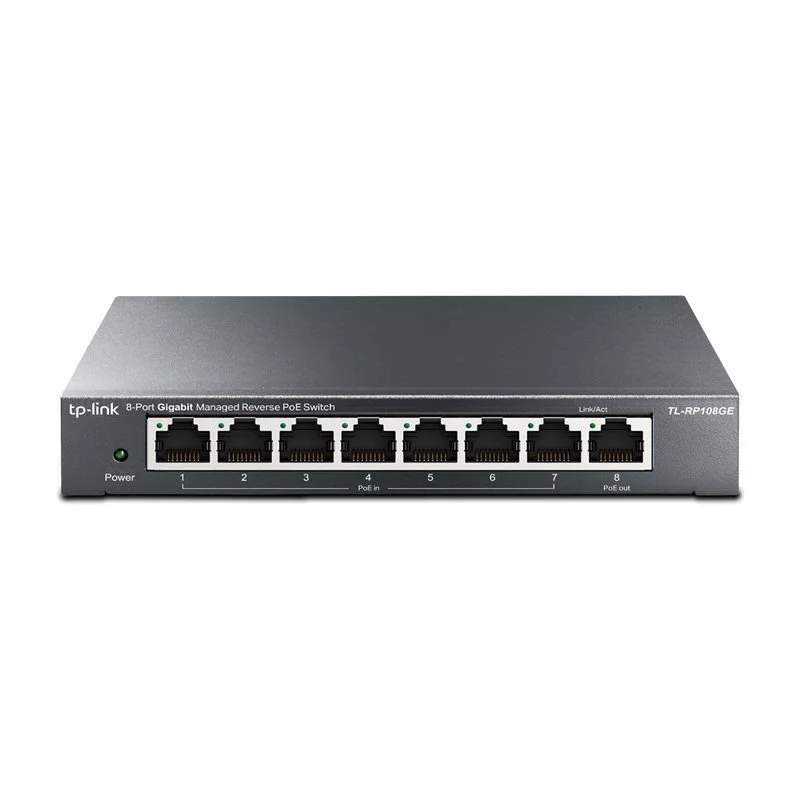 Image 2 of 2
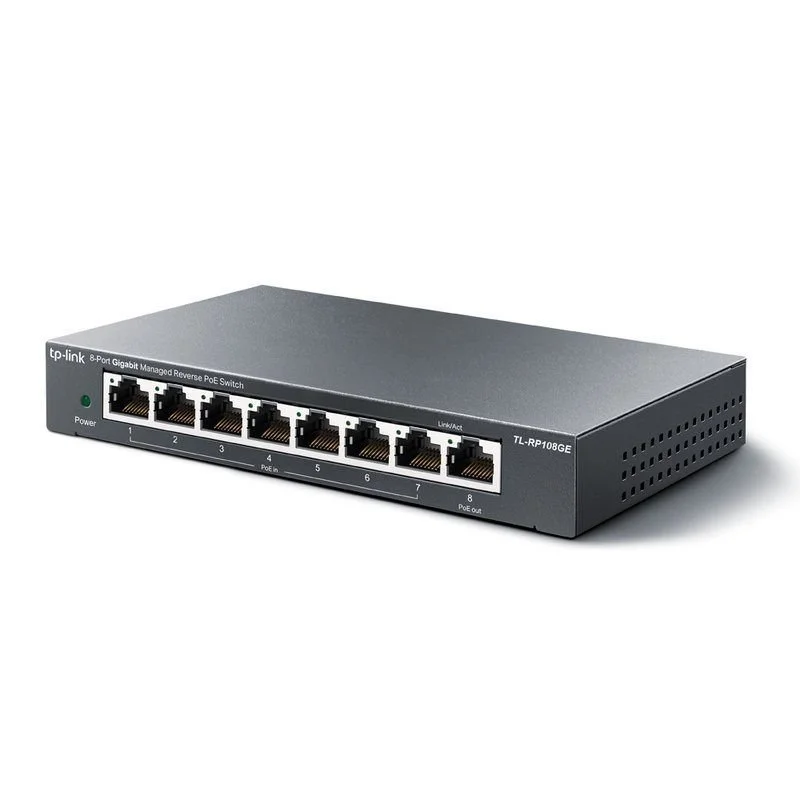
RP108GE
8-Port Gigabit Managed Reverse PoE Switch
Overview A compact, industrial-grade managed switch designed for reverse (passive) Power over Ethernet deployments. The unit supplies power to an upstream PoE-powered device via a single reverse PoE out port while receiving power through multiple PoE-in ports. Built in a durable steel desktop chassis, it combines enterprise-class Layer 2 features with simplified deployment for access points, cameras, and other networked devices where remote power sourcing is required.
Ports
7 × Gigabit Passive PoE In ports (RJ45)
Accept passive PoE power input from upstream PoE injectors or PoE switches
1 × Gigabit Passive PoE Out port (RJ45)
Supplies passive PoE power upstream (reverse PoE)
1 × 5V/12V DC Out port
Configurable/dual-voltage auxiliary DC output for powering small devices or accessories
Management: Out-of-band management via dedicated management interface accessible through web UI and utility software (details in management section)
Physical
Chassis: Steel desktop case for enhanced durability and heat dissipation
Mounting: Desktop or optional surface mount
LED indicators: Per-port link/activity and PoE status, system power LEDs
Power input: Accepts passive PoE power on designated PoE-In ports; internal power handling converts and routes power as configured
Key Specifications
Switching capacity: Gigabit wire-speed switching on all ports
PoE type: Passive PoE (non-standard, polarity- and voltage-specific; verify compatibility)
PoE topology: Reverse PoE support — power sourced from PoE-In ports and delivered out via the single PoE-Out port
DC Out: Selectable 5V or 12V output, suitable for powering small peripherals
MTU: Configurable MTU per port; supports jumbo frames
VLAN: MTU/Port/Tag-based VLAN support (flexible segmentation by port, tag, and MTU)
QoS: Hierarchical QoS with priority mapping and bandwidth control per port
IGMP Snooping: IGMP Snooping v1/v2/v3 for efficient multicast forwarding
Management: Intuitive web management interface and utility software for discovery and basic configuration; supports firmware upgrade via web UI
Security: Port-based access control and basic administrative authentication
Operating temperature: Industrial-tolerant range for indoor installations (check product label for exact range)
Certification: Compliance to regional safety and EMC standards (see product datasheet for specific certifications)
Features and Benefits
Reverse PoE capability: Simplifies topologies where power must be sent upstream to a central PoE-powered device (e.g., powered aggregators, powered AP controllers)
Multiple PoE-In ports: Redundant or aggregated power input options reduce single-point failure risk and increase installation flexibility
Desktop steel housing: Robust construction for longer lifecycle and stable thermal performance
Advanced Layer 2 features: VLAN by MTU/port/tag, QoS, and IGMP Snooping deliver predictable performance for voice, video, and critical data
Simple management: Web UI and utility provide quick setup and central discovery for small to medium deployments
Auxiliary DC output: Built-in 5V/12V DC out provides power for cameras, sensors, or indicator devices without separate supplies
Compact footprint: Keeps rack/desktop space minimal while delivering enterprise-level switching and power management
Typical Applications
Campus and branch networks requiring upstream-powered devices
Wireless deployments where a powered aggregation point must be fed from field-located injectors
Surveillance systems with centralized powered recorders or controllers
Industrial and commercial indoor deployments needing robust steel housing and managed features
Notes and Installation Considerations
Passive PoE compatibility: Passive PoE is not standardized (802.3af/at) — verify voltage and pinout compatibility with connected equipment to prevent damage.
Power budget planning: Confirm total available power from PoE-In sources and the power requirements of the device connected to the PoE-Out port as well as any load on the DC Out port.
VLAN and QoS design: Use MTU/Port/Tag-based VLANs and QoS to separate and prioritize traffic classes (voice/video/data) for deterministic performance.
Firmware and security: Maintain updated firmware and strong administrative credentials. Restrict management access to trusted networks.
What’s in the Box
8-Port Gigabit Managed Reverse PoE Switch
Power adapter or documentation for passive PoE power sourcing (depending on model/region)
Quick start guide and safety instructions
Rubber feet and basic mounting hardware
Ordering Information
Product model: 8-Port Gigabit Managed Reverse PoE Switch (contact sales for exact model number and regional SKUs)
Optional accessories
8-Port Gigabit Managed Reverse PoE Switch
Overview A compact, industrial-grade managed switch designed for reverse (passive) Power over Ethernet deployments. The unit supplies power to an upstream PoE-powered device via a single reverse PoE out port while receiving power through multiple PoE-in ports. Built in a durable steel desktop chassis, it combines enterprise-class Layer 2 features with simplified deployment for access points, cameras, and other networked devices where remote power sourcing is required.
Ports
7 × Gigabit Passive PoE In ports (RJ45)
Accept passive PoE power input from upstream PoE injectors or PoE switches
1 × Gigabit Passive PoE Out port (RJ45)
Supplies passive PoE power upstream (reverse PoE)
1 × 5V/12V DC Out port
Configurable/dual-voltage auxiliary DC output for powering small devices or accessories
Management: Out-of-band management via dedicated management interface accessible through web UI and utility software (details in management section)
Physical
Chassis: Steel desktop case for enhanced durability and heat dissipation
Mounting: Desktop or optional surface mount
LED indicators: Per-port link/activity and PoE status, system power LEDs
Power input: Accepts passive PoE power on designated PoE-In ports; internal power handling converts and routes power as configured
Key Specifications
Switching capacity: Gigabit wire-speed switching on all ports
PoE type: Passive PoE (non-standard, polarity- and voltage-specific; verify compatibility)
PoE topology: Reverse PoE support — power sourced from PoE-In ports and delivered out via the single PoE-Out port
DC Out: Selectable 5V or 12V output, suitable for powering small peripherals
MTU: Configurable MTU per port; supports jumbo frames
VLAN: MTU/Port/Tag-based VLAN support (flexible segmentation by port, tag, and MTU)
QoS: Hierarchical QoS with priority mapping and bandwidth control per port
IGMP Snooping: IGMP Snooping v1/v2/v3 for efficient multicast forwarding
Management: Intuitive web management interface and utility software for discovery and basic configuration; supports firmware upgrade via web UI
Security: Port-based access control and basic administrative authentication
Operating temperature: Industrial-tolerant range for indoor installations (check product label for exact range)
Certification: Compliance to regional safety and EMC standards (see product datasheet for specific certifications)
Features and Benefits
Reverse PoE capability: Simplifies topologies where power must be sent upstream to a central PoE-powered device (e.g., powered aggregators, powered AP controllers)
Multiple PoE-In ports: Redundant or aggregated power input options reduce single-point failure risk and increase installation flexibility
Desktop steel housing: Robust construction for longer lifecycle and stable thermal performance
Advanced Layer 2 features: VLAN by MTU/port/tag, QoS, and IGMP Snooping deliver predictable performance for voice, video, and critical data
Simple management: Web UI and utility provide quick setup and central discovery for small to medium deployments
Auxiliary DC output: Built-in 5V/12V DC out provides power for cameras, sensors, or indicator devices without separate supplies
Compact footprint: Keeps rack/desktop space minimal while delivering enterprise-level switching and power management
Typical Applications
Campus and branch networks requiring upstream-powered devices
Wireless deployments where a powered aggregation point must be fed from field-located injectors
Surveillance systems with centralized powered recorders or controllers
Industrial and commercial indoor deployments needing robust steel housing and managed features
Notes and Installation Considerations
Passive PoE compatibility: Passive PoE is not standardized (802.3af/at) — verify voltage and pinout compatibility with connected equipment to prevent damage.
Power budget planning: Confirm total available power from PoE-In sources and the power requirements of the device connected to the PoE-Out port as well as any load on the DC Out port.
VLAN and QoS design: Use MTU/Port/Tag-based VLANs and QoS to separate and prioritize traffic classes (voice/video/data) for deterministic performance.
Firmware and security: Maintain updated firmware and strong administrative credentials. Restrict management access to trusted networks.
What’s in the Box
8-Port Gigabit Managed Reverse PoE Switch
Power adapter or documentation for passive PoE power sourcing (depending on model/region)
Quick start guide and safety instructions
Rubber feet and basic mounting hardware
Ordering Information
Product model: 8-Port Gigabit Managed Reverse PoE Switch (contact sales for exact model number and regional SKUs)
Optional accessories